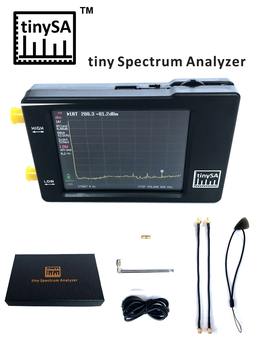
รายละเอียดสินค้า (Product Description)
มองเห็นคลื่นความถี่ที่คุณไม่เคยเห็นด้วย TinySA: เครื่องวิเคราะห์สเปกตรัมขนาดจิ๋วที่ทรงพลังระดับมืออาชีพ TinySA คือนวัตกรรมเครื่องมือวัดสัญญาณวิทยุ (RF) ที่ย่อส่วนเทคโนโลยีระดับห้องปฏิบัติการมาไว้ในขนาดพกพา ออกแบบมาเพื่อช่างเทคนิค, วิศวกร และนักเล่นวิทยุสื่อสารที่ต้องการวิเคราะห์สัญญาณในช่วงความถี่กว้าง ตั้งแต่ MF/HF ไปจนถึง VHF/UHF ได้อย่างแม่นยำทุกที่ทุกเวลา
🎯 ฟีเจอร์เด่นระดับโปร (Key Highlights):
-
Ultra-Wide Frequency Range: รองรับการวัดสัญญาณตั้งแต่ 100kHz ไปจนถึง 960MHz ครอบคลุมการใช้งานวิทยุสื่อสาร, รีโมทคอนโทรล, สัญญาณดาวเทียม และระบบไร้สายต่างๆ
-
Dual Input Modes: * Low Input (100kHz – 350MHz): สำหรับสัญญาณความถี่ต่ำที่ต้องการรายละเอียดสูง
-
High Input (240MHz – 960MHz): สำหรับการวัดสัญญาณความถี่สูงระดับ UHF
-
-
Built-in Signal Generator: ไม่ได้เป็นเพียงตัวรับ แต่สามารถสลับโหมดเป็นเครื่องกำเนิดสัญญาณ (Signal Generator) เพื่อใช้ทดสอบและปรับจูนวงจร RF ได้ในตัวเดียว
-
2.4″ & 2.8″ Touch Screen Display: หน้าจอสีแสดงผลสเปกตรัมชัดเจนแบบ Real-time พร้อมระบบสัมผัสที่ช่วยให้การ Mark จุดความถี่และปรับค่าพารามิเตอร์ต่างๆ ทำได้ง่ายและรวดเร็ว
-
Pocket-Sized & Portable: ขนาดกะทัดรัดพกพาสะดวก พร้อมแบตเตอรี่ในตัวที่ชาร์จผ่านพอร์ต USB ช่วยให้ทำงานภาคสนามได้โดยไม่ต้องง้อปลั๊กไฟ
📋 ข้อมูลทางเทคนิค (Specifications):
-
ความละเอียดการแสดงผล: 320 x 240 pixels
-
ช่วงความถี่ใช้งาน: 100kHz ถึง 960MHz
-
อินเทอร์เฟซ: SMA Connector (พอร์ตมาตรฐานสำหรับงาน RF)
-
ฟังก์ชันการแสดงผล: Spectrum Analyzer, Signal Generator, Frequency Counter
-
การเชื่อมต่อ PC: สามารถเชื่อมต่อคอมพิวเตอร์เพื่อแสดงผลหน้าจอขนาดใหญ่และบันทึกข้อมูลได้
Characteristics:
1. It is equipped with an internal calibration signal generator. When not used as a spectrum analyzer, it can function as a signal generator with two frequency outputs: medium frequency/high frequency /VHF sine output ranging from 0.1MHZ to 350MHz, and UHF square wave output ranging from 240MHz to 960MHz. It is used for automatic self-checking and low-input calibration.
2. This spectrum analyzer features two inputs: a high-quality MF/HF/VHF input ranging from 0.1MHZ to 350MHZ and a low-quality UHF input from 240MHZ to 960MHz.
3.PC control. This spectrum analyzer can be connected to a PC via USB and implements the USB Serial communication (CDC) protocol, which can invoke a large number of commands. After connecting to the computer, the driver will be downloaded automatically.
4.ESD protection function. The latest version 3.1 features a brand-new ESD protection function, with diodes installed, which endows it with more sensitive response performance, efficient anti-static level, better quality and longer service life.
5. Connect to a PC via USB to become a spectrum analyzer controlled by a PC.
The rechargeable battery allows for at least 2 hours of portable use.
Specification:
– Material: ABS
– Colour: Black
– Battery: 1* lithium battery, 650mAh (inclusive)
– Packaging size: 200*120*30mm/7.9*4.7*1.2in
– Packaging weight: 250 grams /8.8 ounces


Technical indicators:
– User interface
– The display resolution is 320*240 pixels
– Screen diagonal: 2.8″
– Each RGB pixel is 16 bits
– Resistance touch control
– Point-action switch control
– USB serial port control
– Optional TTL USART ports on the internal PCB (software not yet implemented)
– Linear power supply for suppressing switching noise
The input/output specifications of tinySA are divided into four modes.
Low input mode specification:
– The input frequency range is from 100KHz to 350MHz.
– When the input attenuation is set to 10dB or more, the input impedance is 50 ohms.
– The input attenuation can be selected between 0dB and 31dB manually or automatically, with a step size of 1dB.
– Absolute maximum input level, no attenuation +10dBm.
– Absolute maximum input power, short-term attenuation 30dB, attenuation +20dBm.
– The input interception point of the third-order modulation product (IIP3) has a 0dB attenuation of +15dBm.
– At the 1dB compression point of +2dBm, the attenuation is 0dB.
– The power detector has a resolution of 0.5dB and a linear frequency of +/-1dB.
– The absolute power level accuracy after power level calibration by +/-1dB.
– Use the lowest resolvable signal with a resolution bandwidth of -102 DBM at 30KHz.
– The frequency accuracy is equal to the selected resolution bandwidth.
– The phase noise at 100 KHZ offset is -90dB/Hz, and at 1MHz offset it is -115dB/Hz.
– When a resolution bandwidth of 70dB at 30KHz is used, there is no stray dynamic range.
– Manual selectable resolution filters at 3, 10, 30, 100, 300, and 600KHz. Automatically select one of the 57 resolution filters.
– The screen resolution of 51, 101, 145 or 290 measurement points.
– Using the filter with the highest resolution, the scanning speed exceeds 1000 points per second.
– Automatically optimize the actual scanning points to ensure coverage of the entire scanning range, regardless of the selected resolution and bandwidth.
– Spurious suppression options are used to evaluate whether certain signals are internally generated or actually exist in the input signal.
High input mode specification:
– The input frequency range is from 240MHz to 960MHz.
– The input impedance is related to the frequency and deviates by 50ohm.
– Due to the absence of an input band filter, strong input signals outside the 240MHz to 960MHz range may cause distortion of the in-band signal.
– Absolute maximum input level, no attenuation +10dBm.
– The input intercept point of the third-order modulation product (IIP3) is -5 DBM.
– The 1dB compression point is -6 DBM with no attenuation.
– The power detector has a resolution of 0.5dB and a linear frequency of +/-1dB.
– The absolute power level accuracy after power level calibration by +/-1dB.
– The minimum recognizable signal using a 30KHz resolution bandwidth of -115 DBM.
– The frequency accuracy is equal to the selected resolution bandwidth.
– When using a 30KHz resolution bandwidth of 50dB, there is no stray dynamic range.
– Manual selectable resolution filters at 3, 10, 30, 100, 300, and 600KHz. Automatically select one of the 57 resolution filters.
– Optional 25dB to 40dB frequency-dependent input attenuators are available. The power stage error of this attenuator increases to +/-10dB when activated.
– The screen resolution of 51, 101, 145 or 290 measurement points.
– Using the filter with the highest resolution, the scanning speed exceeds 1000 points per second.
– Automatically optimize the actual scanning points to ensure coverage of the entire scanning range, regardless of the selected resolution and bandwidth.
Low output mode specification:
– A sinusoidal output with harmonics 40dB lower than the fundamental.
– The output frequency range is from 100KHz to 350MHz.
– The output level can be selected in 1dB steps between -76 DBM and -6 DBM.
– Optional AM, narrow FM and wide FM modulation or slow sweep within the optional frequency range.
– The optional output level offers maximum scanning across the entire output level range.
High output mode specification:
– Square wave output.
– The output frequency range is from 240MHz to 960MHz.
– The output level can be selected in variable increments between -38 DBM and +13dBm.
– Narrow and wide frequency modulation or slow sweep within the selectable frequency range are available.
Reference generator specifications:
– Optional square wave output with a fundamental wave of -25 DBM, connected to high input/output.
– The frequency can be set to 1MHz, 2MHz, 4MHz, 10MHz, 15MHz or 30MHz.

 Battery specification:
– The maximum charging time on a 500mA minimum USB port or USB charger is 1 hour.
– Run on a fully charged battery for at least 2 hours.
List of items:
– 1 x spectrum analyzer
– 2 x shape memory alloy cables and barrel connectors
– One antenna with a shape memory alloy connector
– 1 x USB-C cable
– 1 x Touchscreen baffle